


What will happen, can happen, or should happen when the Social Security trust fund becomes technically insolvent in the early 2030s? This month, we present three recent research papers that attempt to answer those questions.
Two of the three papers come from scholars of the American Enterprise Institute, via The Journal of Retirement. A third comes from a retired actuary and Certified Financial Planner who frames Social Security through the lens of Modern Monetary Theory.
None of these papers calls for a change in Social Security’s basic payroll-tax-fund structure. The first two recommend cutting benefits on the “rich” rather than explicitly raising anybody’s taxes. The third paper suggests the creation of a voluntary national defined contribution plan in addition to Social Security.
“A Simple Plan to Address Social Security Insolvency,” Andrew Biggs and Kristin Shapiro. The Journal of Retirement, Fall 2025.
“The question that is truly at stake in Social Security reform: Should we increase taxes to maintain full benefits for high-income retirees?” Andrew Biggs of the American Enterprise Institute and his co-author, Kristin Shapiro, of Cleveland law firm Baker Hostetler, write.
They recommend capping the Social Security benefit at about $2,050 (in 2024 dollars) a month. People currently receiving less than that amount would still receive all of their promised benefits, but nobody would receive more. That would reduce expenses by 21% and the program wouldn’t be guilty of paying out benefits in excess of its revenues.
In the event that Congress couldn’t solve the problem before Social Security’s trust fund went into deficit, the president could step in, Biggs and Shapiro write. No law would require him to reduce everybody’s benefits by the same percentage. “The President could… choose to create reasonable criteria that would focus the necessary benefit reductions on the retirees who are most able to absorb them.”
This method wouldn’t raise taxes, they say. It wouldn’t reduce benefits for the neediest 80% or pitch anyone into poverty. It wouldn’t even hurt the wealthiest 10% of beneficiaries because they currently rely on their benefits (~$43,000, on average) for only 10% of their retirement income. He considers the possibility that those who lose benefits might sue for them, but believes, based on legal precedent, that they would lose.
“What Happens When the Social Security Trust Fund Is Exhausted: Alternative Contingency Policies,” Mark Washawsky. The Journal of Retirement, Summer 2026.
A long-time advocate of the use of single-premium income annuities in personal retirement financing, Warshawsky, who like Biggs is a fellow the AEI, also describes a no-new-taxes approach to Social Security and preservation of the pay-as-you-go system.
But he reduces Social Security’s liabilities through “means-testing” instead of capping benefits, and takes Australia’s means-test as his model.
Australia offers retirees a basic pension, financed out of general tax receipts. A test of each person’s net worth—the means test—determines how big a basic pension, if any, he or she will receive in a given year. (The basic pension is a safety net for retirees who haven’t accumulated enough savings in Australia’s “Super,” a national, mandatory “collective defined contribution” retirement savings plan.)
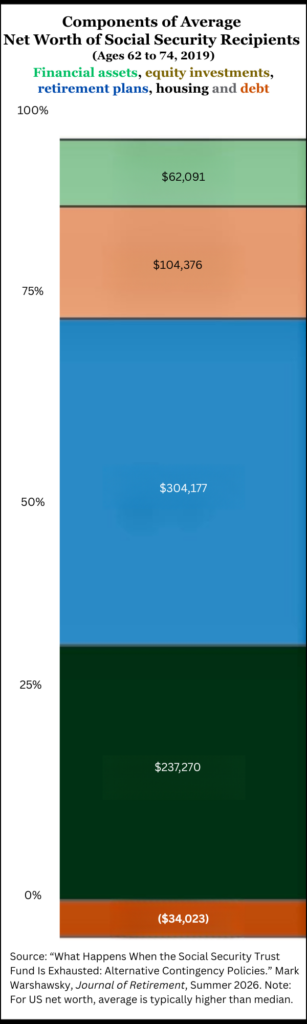
Reductions in Social Security benefits under Warshawsky’s plan would be restricted to those ages 62–74 who are disabled and those with individual (not household) net worths below $470,400 (in 2025 dollars), with partial cuts for those due to receive the median benefit with net worths below $785,400.
“The Forced Bid: What Privatizing Social Security Would Do to Stock Prices, and Why Recent Developments in the Economics of Market Flows Strengthen the Case Against It,” Edward Lane, July 2026.
The “forced bid” in Lane’s paper refers to the potential impact of diverting all or part of the 12.4% Social Security payroll tax into stocks and bonds. That would backfire, he writes. Citing 2021 research, he claims that the increase in demand for securities would create a short-term windfall for large shareholders but no real benefit for most other Americans. In his view, it would push the P/E ratio up and the equity risk premium without offsetting the impact of a shrinking workforce.
“The stock market is not a loophole in demography,” he writes.
Applying Modern Monetary Theory, Lane rejects the idea that Social Security’s predicted insolvency represents a crisis. MMT, for those unfamiliar with it, isn’t a theory but a description of how the U.S. fiscal and monetary system actually works. In MMT, the U.S. government is never broke; therefore Social Security is never broke.
For Lane, permanent solvency for the Social Security trust fund isn’t needed, but it is possible. “If Congress wishes to adjust the program’s internal accounting along the way,” he writes, “raising or eliminating the taxable wage cap will do the job without reducing any worker’s protections.”
“Once solvency is recognized as a non-issue for a currency-issuing government, the Social Security ‘problem’ reduces to a demographic question about future real output, which is smaller and more tractable than the financial crisis the privatizers described,” Lane writes.
“Insolvency was never the binding constraint. Real production was, and the privatization debate spent its life arguing about the wrong one.”
Lane also accounts for the cost of a transition to private accounts. “If workers divert part of the payroll tax into personal accounts,” he writes, “benefits to current retirees do not stop, so the government fills the gap by borrowing. Every dollar that flows into a personal account and then into the stock market is matched, dollar for dollar, by new Treasury bonds sold to the public.”
Similarities and differences
Biggs, Shapiro and Warshawsky find ways to bring the Social Security trust fund into balance without any explicit increases in the payroll tax. For Lane, Social Security’s looming deficit doesn’t create an emergency like the one that, say, an insolvent life insurer faces. For me, Lane makes a much-needed contribution to the Social Security debate by accurately framing the program as cost-effective insurance for its price rather than as a bad investment. In this view, Social Security is not an ugly duckling. It’s a swan.
All four writers mention the “rich.” Biggs makes the fairly large assumption that retirees who qualify for Social Security benefits above $2,050 don’t need the excess. Warshawsky counters that people with high benefits aren’t necessarily rich. He asks why we should all pay higher payroll taxes just to keep Social Security benefits intact for the rich. So he suggests an ongoing test of net worth.
But should retirees be described as “rich” if they have net worths of, say, $1 million, including real estate? Or are they merely the “millionaires-next-door” who prudently saved enough to finance a 20- or 30-year retirement?
Lane suggests that only the rich—existing owners of large amounts of securities—would benefit in real terms, and only at first, from diverting payroll taxes into the equity and bond markets. Conversely, he predicts trouble for a privatized savings system when withdrawals start to exceed contributions.
None of these writers seems to mention the implicit tax hike that high-net-worth workers would face if their future benefits were reduced but not their payroll taxes or, conversely, if their payroll taxes went up (because of an increase in the FICA limit) but not their benefits. Warshawsky admits that means-testing is complicated and labor-intensive, but he believes that it’s working in Australia.
Elections may decide
Social Security’s long-term future is likely to depend on the balance of power in Washington during the next seven years. The elections of 2028, 2030, and 2032 could empower either a no-tax-increase or a no-benefit-cut party. Or elections could produce a divided, deadlocked government unable to compromise on a solution.
This article’s illustration is excerpted from a mural by Seymour Fogel in the Wilbur J. Cohen Federal Building in Washington, D.C.
© 2026 RIJ Publishing LLC. All rights reserved.