

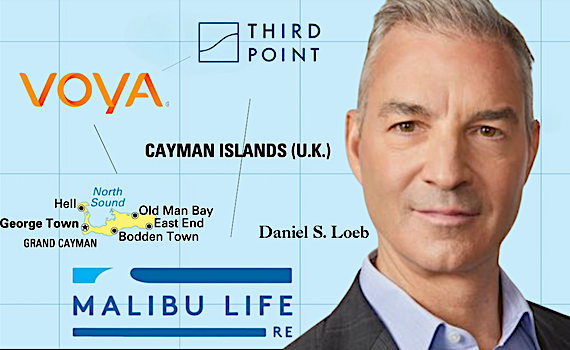
Daniel S. Loeb, the billionaire CEO of asset manager Third Point Investors Ltd., is all-in on the arbitrage that RIJ calls the “Bermuda Triangle.” That’s the synergistic linking of U.S. annuities, private credit, and offshore reinsurance.
Loeb is a latecomer to a semi-mature, crowded, interest rate-sensitive, complex business. It’s a business that has drawn scrutiny from U.S. and global regulators. Presumably, he knows all that. In little over a year, Loeb and his team have:
- Turned their Hudson Yards-based closed-end fund into a London-listed insurance holding company
- Bought Birch Grove, an $8 billion private-credit investment shop
- Established Malibu Life Re, a reinsurer in the Cayman Islands
- Acquired a Texas-domiciled U.S. life insurer
- Hired a veteran Cayman reinsurance executive to run Malibu Life
- Agreed to provide “flow reinsurance” to an unnamed “blue-chip annuity platform”
- Secured equity commitments from Voya and its ReliaStar unit
- Prepared to issue a fixed deferred annuity in the U.S. in the first half of 2026
Loeb’s main departure from the Bermuda Triangle template involves choosing the Cayman Islands instead of Bermuda as Malibu’s headquarters. [See Malibu Re’s recent investor presentation.]
Otherwise, he’s following the playbook written by Apollo/Athene, KKR/Global Atlantic, Brookfield/American Equity, etc. Like them, Loeb has set up the pure version of the Triangle. It can issue and reinsure it own fixed deferred annuities offshore, do “block” or “flow” reinsurance for others, dabble in pension risk transfer (PRT) deals, originate private debt and sell tranches of bundled high-risk loans to its own insurer.
Hiring seasoned experts
Key staffers in the new venture include Loeb, Robert Hou, and Gary Dombowsky. Loeb, 63, is not a direct descendant of the founders of the investment firm Kuhn, Loeb & Co. (which lasted from 1867 to 1984). His father, Ronald, was a director and briefly president at Mattel. His great-aunt, Ruth Handler, created Mattel’s Barbie doll.
A 1984 economics graduate of Columbia, Loeb worked in distressed debt and high-yield bonds as an executive at Jeffries LLC and Citicorp, respectively, in the early 1990s. He started Third Point Management in 1995 “with $3.3 million from family and friends.”
Robert Hou, who will serve as Malibu’s COO, joined Third Point in 2021 from Blackstone’s Insurance Solutions Group. He had helped launch that group, which now manages hundreds of billions of dollars in insurance company assets. In 2023, Loeb hired Christopher Taylor, CEO of private credit specialist Apogem Capital, to lead Third Point’s private credit team. Last month, three former Apogem private credit professionals joined Third Point, Bloomberg reported in October.

Gary Dombowsky
For experience running a reinsurer in the Cayman Islands, Third Point hired Gary Dombowsky as CEO of Malibu. Dombowsky had co-founded Knighthead Annuity & Life with $230 million raised from 30 investors in 2014. His co-founder, Nate Gemmiti, is now CEO of Cayman-based Triangle upstart Ibexis Life & Annuity.
In October 2020, Dombowsky and Gemmiti founded the Cayman International Reinsurance Companies Association (CIRCA). The two had a shared history at Scottish Re’s since-defunct reinsurance operations (later bankrupt) in the Cayman Islands. Dombowsky left Knighthead and joined Malibu this year.
Third Point’s makeover
In its new organization, Third Point owns all of Malibu Holding, which owns all of Malibu Life Re and TruSpire. Malibu Life Re owns all of Malibu Life Re Segregated Portfolio 1.
TruSpire, which Third Point last month announced plans to acquire from Mutual of America by early 2026 for about $45 million. The life B++ insurer is licensed in 44 states. It’s a member of the Federal Home Loan Bank, a key lender of low-cost funds to Bermuda Triangle companies.
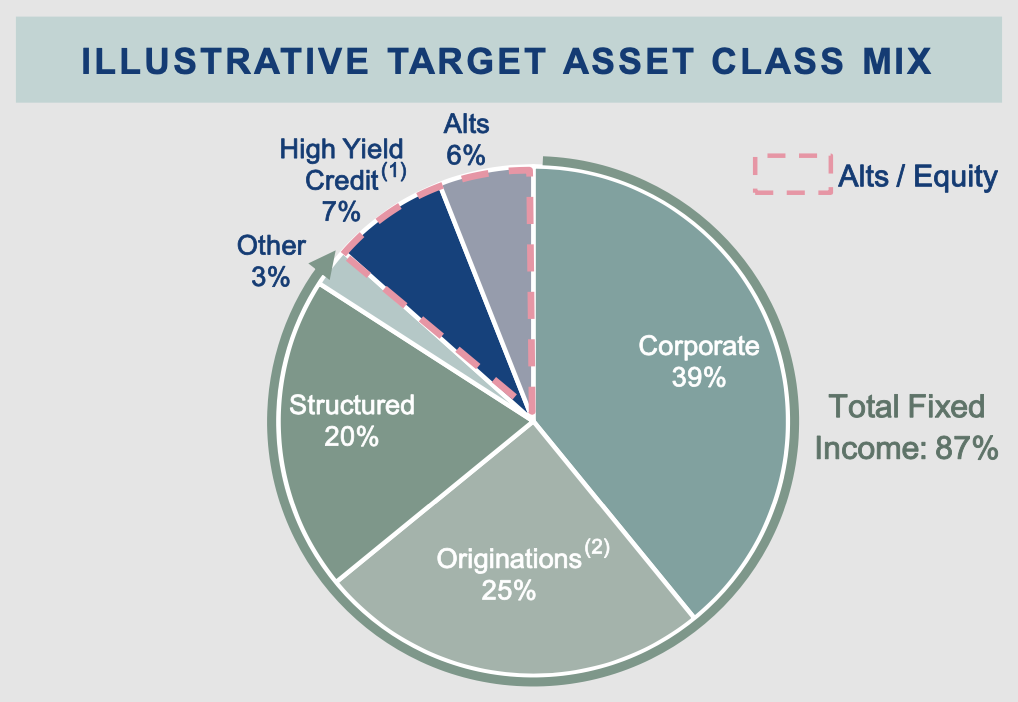
Malibu Re’s target asset class mix. Source: Third Point Investors Presentation, July 2025.
Mutual of America had acquired Landmark Life in October 2023 and renamed it TruSpire with the intent of selling fixed index annuities and competing for PRT deals. AM Best gave TruSpire an a- (Excellent) rating two years ago but updated that to bbb+ (Good) and “under review with developing implications” after the Malibu Re deal.
Malibu Life Holdings, at last notice, has been more or less an address in George Town, Grand Cayman. It has so far outsourced most of its functions; its local management and Cayman residency requirement is furnished by a Cayman company, Artex (Artexrisk.com).
Malibu Life Re has already reinsured $981 million in annuity liabilities (on a 25% quota share, funds-withheld coinsurance basis) for an unnamed “blue-chip” U.S. annuity platform that was established in 2020. There’s an estimated $2 billion more in that pipeline.
Voya is also in the picture, as an investor, and possibly more. Voya Retirement Insurance and Annuity and Voya-unit ReliaStar Life Insurance Company both agreed last July to buy up to $25 million in ordinary shares of Malibu.
Is Voya Malibu’s anonymous blue chip reinsurance partner? A Voya spokesperson offered a “no comment” response.
Malibu’s acquisition of private credit specialist Birch Grove, which raises Third Point’s total AUM to ~$21 billion, should give Third Point new expertise in finding borrowers, originating leveraged loans and bundling the loans into collateralized loan obligations (CLOs).
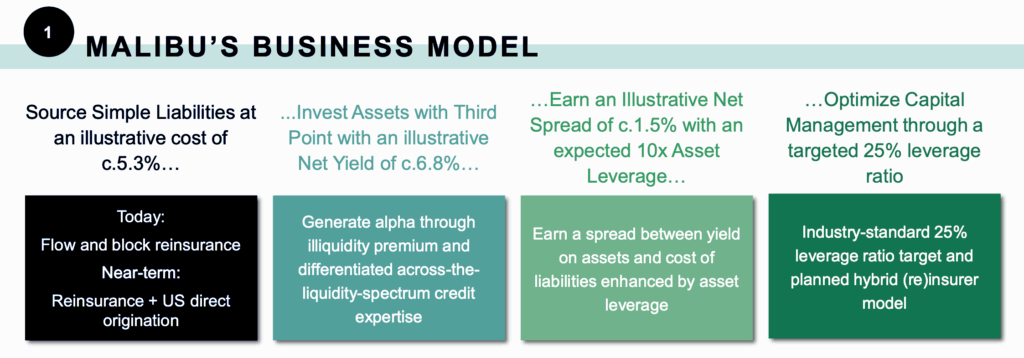
From Third Point Investors presentation
Malibu’s prospectus included this statement about its investment philosophy: “For assets backing reserves, Third Point will invest predominantly in high quality fixed income securities with robust cash flow modeling to match liability cash flows which prioritizes income and preservation of capital and mitigates market risks. For surplus assets, Third Point will invest prudently in return-enhancing assets while considering their volatility and impact on Malibu’s capital.”
[This approach may strike readers as counterintuitive. Unlike, say, the salt line between a river and the sea it empties into, there’s no clear line in an insurer’s general account between surplus assets and reserve assets. The capital and surplus are simply the excess of assets (what others owe the insurer) over liabilities (what the insurer owes others). As a rule, practitioners of the pure Triangle strategy (e.g., Apollo and KKR) minimize their surpluses and maximize their “return-enhancing” assets. On its face, Third Point’s stated investment strategy sounds prudent—but potentially inconsistent.]
Why Third Point rushed into the Triangle
In 2024, Third Point’s back was to the wall. Its flagship closed-end fund was trading at a 20% discount. Investment returns were lagging the benchmark. Its investors were restless. In August 2024, Loeb created a team to brainstorm a corporate reboot.
Loeb’s decided to do a “reverse takeover” that would turn Third Point into London-listed Malibu Life Holdings and clone the Apollo/Athene insurance strategy. That proposal didn’t please all the investors, who marshalled opposition to it.
One Third Point investor told the Financial Times in August 2025 that the proposed business was a latecomer in a crowded field. “Every alternative asset manager now has some sort of reinsurance or insurance client,” said Tom Treanor of Asset Value Investors, part of the investor group opposed to the takeover.
But Loeb, a 25% owner of Third Point, was able to get the 50% vote he needed to push the plan through. Rupert Dorey, chair of the board of Third Point Investors, told the Financial TImes, “The board is confident it has found that balance through a thorough, transparent and independent process, and on behalf of shareholders is genuinely excited by the potential within Malibu.”
Even if Loeb is a latecomer to the party, the party may be getting much bigger. In an August executive order, President Trump blessed the distribution of private credit, crypto, and annuities through 401(k)s. There’s about $9 trillion in U.S. defined contribution plans, and trillions more in other retirement vehicles. Whether regulators will remove all barriers to the distribution of alternative assets through qualified plans remains to be seen. BlackRock, Apollo and Empower are campaigning to make sure they will.
What could spoil the party? A couple of things. Changes in interest rates could affect revenues from the sale of fixed deferred annuities, which play a critical role in financing the loans that asset managers bundle into collateralized loan obligations (CLOs). Higher rates, as we’ve seen, make fixed-rate annuities more attractive. Lower rates—which President Trump has demanded—boost equity prices, which boosts the crediting rates of fixed index annuities. The Fed has lowered rates by a quarter-point twice this year.
Legal arbitrage—between state/federal regimes and onshore/offshore regimes—is also essential to the success of the strategy. Any new regulations that shrink the benefits of offshore reinsurance or spoil the internal synergies of the pure Triangle strategy (where counterparties are sometimes closely-affiliated rather than at arm’s-length) could hurt the trend. In any future Democratic administration, the Labor Department may try (again) to reclassify FIAs as securities, or to put regulatory hurdles between them and qualified plans.
Of course, a big credit crisis would wreak havoc with CLO valuations.
© 2025 RIJ Publishing LLC. All rights reserved.