


On a warm, late-April afternoon, I wandered the historic streets of Nashville, thinking about “alternative assets” in life insurance investment portfolios and 401(k) plans. The honky-tonks were open. Light beer flowed from a hundred taps. Country-rock spilled muddily from open windows onto sidewalks dense with heartland tourists.
Replicas of cowboy bars are a cash cow for Nashville. So are business conferences. A private credit conference had brought me to Nashville. My hope was to expand my understanding of collateralized loan obligations (CLOs) and business development companies (BDCs) and to find out how the private credit industry views annuities and retirement plans.
Since the Great Financial Crisis of 2008, those once-distinct segments of finance have grown closer. Pools of tax-deferred retirement savings–annuities, pensions, and defined contribution plans–are now an established source of financing for high-yield lending to high-risk mid-sized companies. A new McKinsey white paper describes how the life insurance and private credit industries have converged.
That convergence is controversial, however. On the one hand, asset managers have spent lavishly on ads and white papers touting the “democratization” of private credit. In an executive order and a Department of Labor proposal, the Trump administration has touted the value of private credit for 401(k) plans.
But the financial media, especially the Financial Times, has lately framed private credit as an asset class whose value has peaked, that’s not designed or appropriate for retail investors, and that retirement plan participants don’t need. JPMorgan CEO Jamie Dimon characterized some downgraded private credit loans as “cockroaches.”
Co-sponsored by DealCatalyst and LSTA (Loan Syndications and Trading Association), the conference attracted record attendance. I was a panelist in two sessions. One session focused on synergies between life insurance companies and private market products. The other weighed the likelihood that private market assets will be widely offered to 401(k) plan participants as components of target-date funds or, more likely, through CITs (collective investment trusts).
What others are calling convergence, RIJ has called the “Bermuda Triangle.” That’s a business model, pioneered by Apollo more than a decade ago, where annuity-issuers, alternative asset managers and reinsurers work in synergy, in some cases as affiliates inside the same holding company.
Revenues from deferred annuity sales help finance the asset managers’ private lending businesses. High yields from private lending can help the life insurers offer more attractive on crediting rates on their annuities. The (often offshore) affiliated reinsurer assumes a portion of the annuity issuer’s investment risk and reduces its capital requirements. The offshore reinsurer might also reimburse the annuity-issuing life insurer for its distribution costs (e.g., sales commissions).
This strategy has grown over the past 15 years. I have the impression private asset managers recognized Americans’ $40 trillion in tax-deferred retirement savings as potential financing for their high-risk, high-yield lending businesses. Selling annuities was one way to tap into those savings. Getting their investment products into 401(k) plans would be, in the words of one asset manager, “Nirvana.”
Dispelling myths
The Bermuda Triangle strategy isn’t a concept that’s well-understood even within the segments of the industry that uses it. Those who work in one of the industry’s silos may not be able to see it. No one I met at the Nashville private credit conference had heard of it.
Most asset managers believe that large life insurers still mainly sell insurance—either life insurance (which protects families from the financial pain caused by a breadwinner’s premature death) or death insurance (i.e., income annuities that protect retirees from the financial pain of outliving their savings).
That hasn’t been true for decades. Except for the policyholder-owned “mutual” life insurers like New York Life, the leading life insurers primarily sell deferred annuities, not life insurance. In 2025, life insurers’ gross annuity sales ($464 billion) were about 25 times their life insurance premiums ($18 billion). The annuities they sell are primarily sold as tax-deferred investments with guaranteed or variable yields and certain guarantees against loss of principal.
Instead of being decades-long liabilities, deferred annuities have interest-crediting terms of three to 10 years. All annuities can be converted to a retirement income stream, but that’s not what sells them. They sell on yield, tax-deferral, and protection from loss.
That’s the key to the alignment of life insurers and alternative asset managers.
Were life insurers still merely transferring long-term biometric risk from individuals to themselves, they could mitigate that risk by pooling millions of life-spans, and they could probably finance it by investing their reserves in publicly-traded corporate bonds.
But those plain-vanilla corporate bonds, held to maturity, don’t furnish enough yield to allow annuity-issuers to offer attractive rates of return to yield-hungry buyers of deferred annuities. So annuity-issuers, like their clients, must reach for yield.
How big is the annuity opportunity for alt-asset managers? Individual annuity reserves at U.S. life insurers at the end of 2025 were $2.8 trillion, up from $2.1 trillion ten years earlier. That’s a $700 billion increase in individual annuity reserves since 2015. There’s another $1.3 trillion in group annuities.
But those numbers are somewhat misleading. Of $2.8 trillion in individual annuity reserves, more than half—about $1.6 trillion—exists in variable annuity separate accounts. The life insurer has no discretion over the investment of separate account money; the individual contract owners do. Much of it is invested in equity mutual funds, and the S&P 500 Index has more than tripled in value since 2015. So a big percentage of the last decade’s increase in annuity reserves has come from stock market appreciation, not net growth of annuity-issuer general account assets.
I discovered my own misconception about the life insurers’ investments in private credit. Annuity-issuing life insurers aren’t necessarily nibbling at, for instance, the senior-most tranches of collateralized loan obligations (CLOs) in search of a few basis points of risk-adjusted yield for their general accounts. Life insurers can be the initial, “anchor” tenants of newly-created CLOs.
401(k) plans
My other panel addressed the idea of “democratizing” access to alternative assets by making them available to 401(k) participants. Last August, a Trump executive order suggested that alternative assets such as private market assets, cryptocurrency and even tontines be included in 401(k) plan investment line-ups. (Chart below compares/contrasts characteristics of private market assets.)
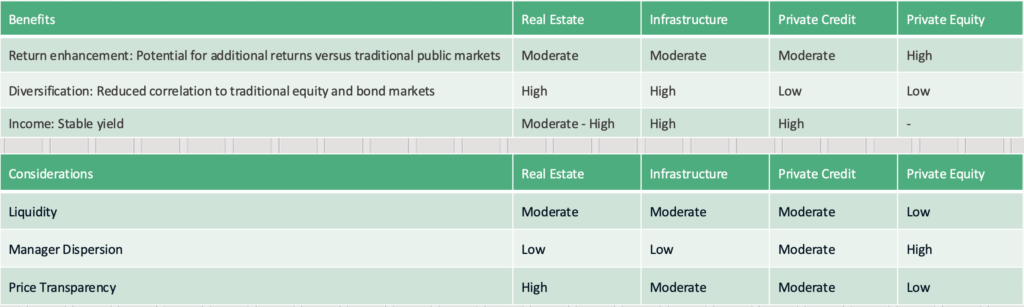
Source: Defined Contribution Institutional Investment Association, April 2026.
The Trump DOL followed suit in March 2026. Daniel Aronowitz, the head of the DOL’s Employee Benefits Security Administration, proposed a “safe harbor”—a due diligence process—that plan sponsors and their fiduciary advisers might rely on to protect them from lawsuits charging them with offering their participants unsuitably risky, complex, illiquid or expensive investments. The public comment period on that proposal ends July 1.
Private credit specialists also seem to have misconceptions about the 401(k) market.
“Democratization” in this case doesn’t mean that participants will be able to invest directly in private market assets. Rather, private market assets will become ingredients in the diversified recipes of the professionally-managed “target-date” omnibus investments (served up as funds-of-funds or collective investment trusts) or managed accounts into which participants who don’t choose their own investments can be automatically assigned. Allocations to private market assets could end up as between 5% and 15% of these default investments.
These are the two types of qualified default investment alternatives (QDIAs). The Pension Protection Act of 2006 lets plan providers invest the contributions of “auto-enrolled” participants who didn’t actively join the plan or pick their own investments into a QDIA.
Neither plan sponsors nor participants are clamoring for such investments, I said at the conference. Alt-assets might help or hurt the savings outcomes of participants. They might enhance yields and help stabilize plan balances over long holding periods.
But participants often change jobs, and many cash-out their tax-deferred accounts or roll the money into IRAs when they do. Christine Benz, Morningstar’s investment pundit, has called alt-assets in 401(k) plans a “solution in search of a problem.”
Capturing 5% to 10% of the trillions of dollars in target-date QDIAs could vastly raise the amount of cash that alt-asset managers can steer toward private market investments. But the opportunity isn’t quite as big as it may initially appear to be.
Of the $14 trillion in defined contribution plans, about $10 trillion is in 401(k) plans. Of that amount, about 40% or $4 trillion is in target-date strategies. If the allocation to private market assets in target date strategies were to reach 10%, that would put the current opportunity for private marketeers at more modest $400 billion. That’s a lot, but not an immediate bonanza.
At least two of the major 401(k) plan providers—Fidelity and Empower—have decided to put private market assets into their target-date collective investment trusts (CITs) for 401(k) plans. JP Morgan has included real estate in its target-date CITs for some time. Another major 401(k) plan provider, Vanguard, offers CITs but they don’t include alternatives. If Vanguard changes course, that would mark a turning point in favor of the inclusion of private credit in 401(k) plans.
© 2026 RIJ Publishing LLC. All rights reserved.