

The cost of health insurance shouldn’t be an American retiree’s biggest financial worry; Medicare does much of the heavy lifting. But Medicare isn’t free, nor are Medicare supplements. Insurance premiums, co-pays, deductibles are additional future expenses that retirees, or retirees’ financial advisers, shouldn’t ignore.
And then there’s the Medicare surcharge (the “IRMAA”) and possibly the costs of “continuing care,” long-term care or LTC insurance. Some of these health care-related expenses are foreseeable while others are, as the aging mind and body discovers, quite unpredictable.
But now there are apps for that. And there’s research that might inspire advisers to add such apps to their retiree toolboxes.
In a report published earlier this year, HealthView Services, a Middleton, Massachusetts firm that produces the apps and generates the research, presented national actuarial data (based on 530 million health care cases) showing that for an average healthy 65-year-old couple, total annual healthcare costs for traditional Medicare programs commonly selected by advised clients, which includes Parts B, D, Medigap (Plan G) and out-of-pocket expenses, will rise from $14,678 in the first year of retirement to $49,094 at age 85, assuming that the man lives to age 88 and a female spouse to age 90.
Over a couple’s lifetime (48 person-years in the example), HealthView projects combined healthcare costs of $581,587 (in today’s dollars) or $839,596 (in future, inflation-adjusted dollars). Those estimates don’t include long-term care expenses or Medicare surcharges (the IRMAA, or Income-Related Monthly Adjustment Amount) on single Medicare beneficiaries with taxable income (in 2026) over $109,000 or couples earning over $218,000.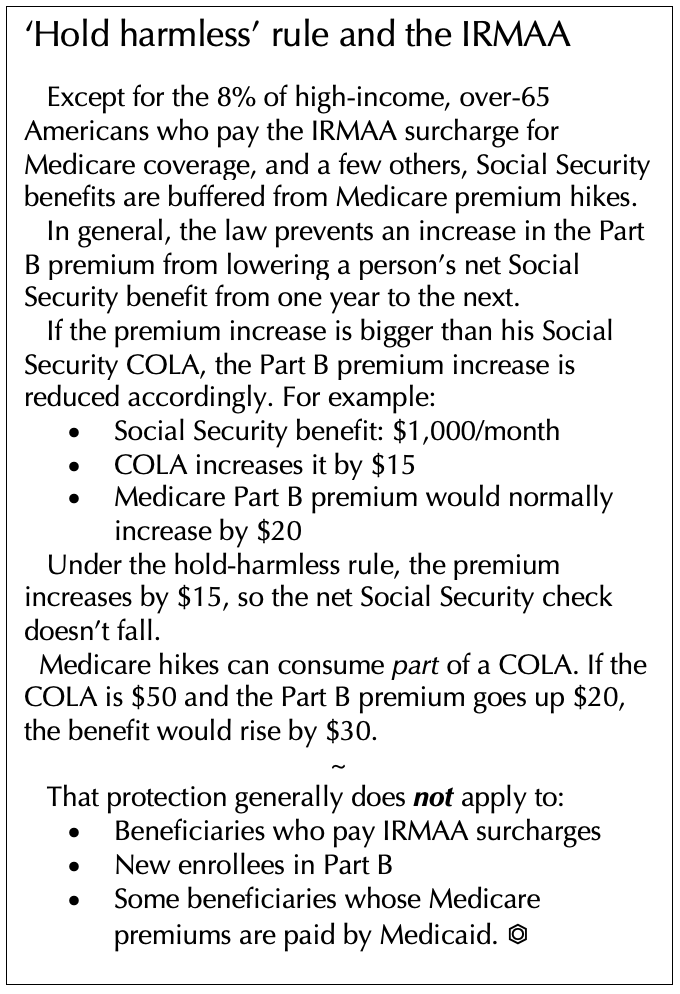
( Kiplinger.com reports that “The IRMAA Part B surcharge [for 2026] ranges from $81.20 to $487.00 monthly, or $974.00 to $5,844.00 annually, on top of the base premium of $202.90. The IRMAA surcharges for Part D in 2026, based on the national base beneficiary premium of $38.99, range from $14.50 to $91 per month, or an annual rate of $174 to $1,092.)
HealthView updates its estimates regularly. Fidelity Investments has published similar data in the past. If their estimates are shocking, it’s mainly because they’re lump-sum present-values and future-values. In the real world, most people experience health insurance premiums as a flow of payments, not a single payment. Also, Medicare premiums are deducted from Social Security benefits, so much of the pain is indirect.
On the other hand, with the costs of health insurance and health care rising faster than the Consumer Price Index and possible cuts in Social Security looming—and with advised clients most likely to be among the 8% of high-income Americans who will pay the IRMAA—knowledge of post-65 health care costs and how best to finance them could well be a value-add for advisers.
One way to prepare for lower Social Security benefits would be to pre-fund the gap left by the potential cuts, which HealthView expects to range from 17% to 22%, depending on each retiree’s current benefits, according to a July 2026 HealthView white paper, “Social Security Solvency & Retirement Planning: Calculating Lost Benefits and Income Solutions.”
“Assuming a 6% annual rate of return, an average-earning couple would [at age 54] need to put aside an additional $52,000 to $55,000 today to generate annual withdrawals sufficient to make up for a 17% decline in Social Security benefits. A high-income couple will require between $123,000 and $130,000,” the paper said.
Health care expenses in retirement vary with health status, lifestyle habit, income, state of residence and gender, HealthView data shows. The projected costs for an individual or couple with Type 2 diabetes would be significantly lower due to shorter life expectancy.
Women live longer than men but have lower Social Security benefits, so they face a special challenge; added longevity increases their average retirement healthcare costs by about 15%. “When a partner passes away, women from more affluent households potentially face the dual challenges of lower retirement income and higher Medicare premium surcharges based on MAGI,” the report said
RIJ’s takeaway: Illness during retirement and outliving one’s savings pose financial adversities that may or may not occur, depending largely on how long one lives. Given their high costs and uncertain occurrence, these are the precisely types of risk that most people—all but the wealthiest—can finance most efficiently with insurance—especially mandatory social insurance, which spreads those risks across the largest possible populations.
That’s the rationale for Social Security and Medicare, and why most Americans are grateful for them. Investments are about taking financial risk to accumulate wealth. Insurance is about offloading financial risk to preserve wealth. Each plays an important role in retirement income planning.
© 2026 RIJ Publishing LLC.