


When I heard about the SEC investigation of Mark Walter, Guggenheim Partners, Delaware Life and Clear Spring Life, I thought:
Maybe this will bring some overdue attention to the regulatory arbitrage that RIJ calls the Bermuda Triangle strategy. If it takes the reflected glory of the World Series Champion Los Angeles Dodgers to focus the nation’s attention on that strategy—of financing high-maintenance, high-yield, risky loans with low-maintenance, low-yield retirement savings—into sensational news, so be it.
Subsequent thoughts, in no particular order:
- Isn’t lending to affiliates why “alternative asset managers” (aka buyout firms, aka private or private credit managers, former ‘Barbarians-at-the-Gate’) like Apollo, KKR, and others buy (or start or partner with) life insurers? Isn’t that why the life insurers sell fixed deferred annuities? Isn’t that why they set up affiliated reinsurers in Bermuda or the Cayman Islands to tamp down their capital requirements and finance their distribution expenses?
- Didn’t Mark Walter only a month ago, in a ceremony in the former Rose Garden, break tradition to give Donald Trump a jewel-encrusted World Series ring along with the honorary name-jersey that sports champions customarily give presidents?
- Didn’t the SEC investigate Walter for self-dealing back in 2018? Hadn’t the Wall Street Journal reported that he used life insurer money to buy an $85 million mansion (that the Pacific Palisades fire later destroyed)?
- Were insurance regulators in Delaware Life and Clear Spring Life’s home state of Delaware on top of the affiliated loans? If not, why not?
For anyone new to the Walter/Delaware Life/Dodgers drama, the Wall Street Journal and other media outlets recently revealed that a whistleblower had told federal regulators that Walter’s life/annuity companies had made many more affiliated loans than it had reported on its statutory filings.
A federal investigation led to a grand jury and a subpoena earlier this year of the records of Delaware Life and Clear Spring. It turned out that not 3% but 42% of Delaware Life’s assets were invested in affiliated companies, and that the total value of affiliated transactions was $17 billion more than reported.
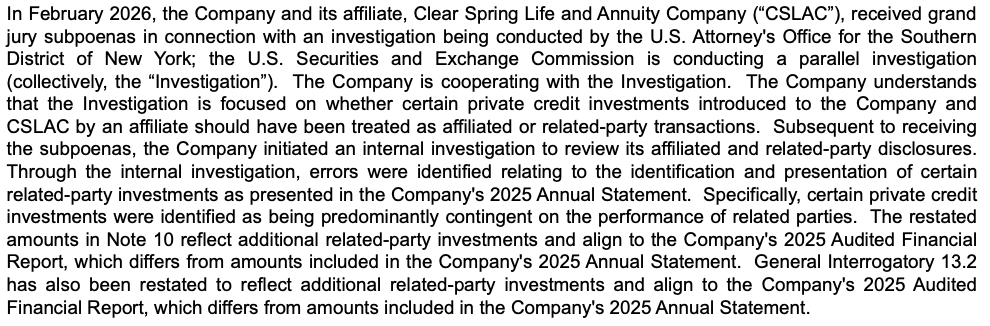
From Delaware Life’s latest statutory filing, p.7.2
According to its 2Q2026 statutory filing, Delaware Life had assets (excluding $18.5 billion in separate accounts) of $46.6 billion and a surplus of $3.9 billion for a middle-of-the-industry surplus ratio of about 8%. At $17 billion, transactions whose value depended on the performance of affiliated private credit assets—illiquid assets of potentially questionable value—were therefore worth more than its surplus.
Walter has since taken initial steps to bring down the percentage of affiliated assets to 39%, and then to 26%. In a slide deck that Delaware Life shared during its recent Second Quarter 2026 Investor Day presentation, the company described its Affiliated Reduction Plan & Control Remediation Plan Update. There’s a brief discussion there of what that entails (see below).

But this investigation, and the reporting on it, is in danger of missing the bigger picture. As Valmark CEO Larry Rybka spells out clearly in his white paper in today’s issue of RIJ, as does this new research paper from Yale, the ownership of life insurers and reinsurers by alt-asset managers can easily, if abused and not properly regulated, become what in common parlance we used to call a racket.
Even if an alt-asset-manager-led life insurer made only unaffiliated loans, the real problem—affiliations of life insurers and asset managers for the purpose of taking risks with retirement savings—would still exist. The conflict occurs at the institutional level, not just at the loan level. The strategy’s practitioners see synergies, not conflicts. To use tech jargon, the conflict is a feature not a bug.
This incident is also revealing the hidden affiliations between the owners of insurance holding companies. The Wall Street Journal has shed light on ties between Mark Walter and Security Benefit’s Todd Boehly, and between Sammons and Guggenheim Partners (though Sammons claims to have diversified its investment management), and between Walter and Mubadala, the Abu Dhabi sovereign wealth fund.
The Journal reported that in April 2025, Walter’s conglomerate, TWG Global, had announced that Mubadala, the Abu Dhabi fund, would help it raise $10 billion in new equity. Mubadala is an investor in Aquarian Holdings, a $27 billion asset manager that bought Investors Heritage Life in 2018, then Hudson Life, then Somerset Re, then established Neptune Reinsurance, then, in 2025, bought Brighthouse, formerly MetLife’s retail annuity business.
Federal Reserve economists have been raising flags about this phenomenon since the early 2010s, identifying private credit as “shadow banking” and offshore reinsurance “as shadow insurance.” At least six years ago, other Fed economists identified the triple play of affiliated asset managers, life insurers and reinsurers. RIJ has been writing about the phenomenon since 2020. For the latest research on these structures, see the research cited in RIJ today by Eileen Appelbaum of the Center for Economic Policy and Research.
Maybe the Dodgers angle will finally bring this complex topic, and all its implications about wealth concentration and diluted financial regulation, to the level of national debate.
© 2026 RIJ Publishing LLC. All rights reserved.