


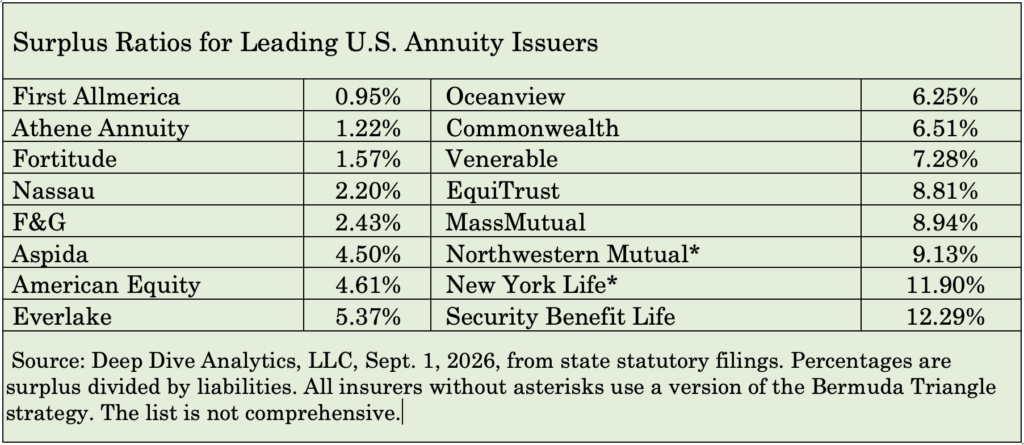
Life insurers used to brag about the size of their surpluses, aka their capital buffers against loss. Today, asset manager-led life insurers in the Bermuda Triangle are more likely to brag about their “capital efficiency” and intention to run “capital-light” companies.
That’s Wall Street-speak for more leverage. Leverage—borrowing to invest—is a normal part of finance. Insurance is an inherently leveraged business, floating on the savings of its customers. Used successfully, leverage can multiply returns on equity capital. But, in a financial crisis, if the borrowed money is secured by collateral that’s also borrowed, and whose value is subject to market volatility, leverage can multiply the risk of loss or insolvency.
Bermuda Triangle companies—annuity-issuing life insurers with affiliated alternative asset managers and offshore reinsurers—tend to carry a lot of leverage. Collectively, these powerful combinations have leveraged hundreds of billions of dollars in annuity sales revenue and borrowed billions more from institutional investors, primarily to finance the asset managers’ high-yield private-credit loans to already-leveraged firms.
Their degrees of leverage are hard to measure. The life insurers’ annuity contracts are complex. The asset managers’ loans to middle-market companies are by nature high-risk, complex, illiquid and bespoke. Simultaneously serving as borrowers and lenders, affiliated life insurers and asset managers can at times control both sides of large transactions. The operations of their holding companies, which straddle state, federal and international jurisdictions, have both worried and frustrated regulators and watchdogs. They see the growth of the strategy as a potential threat to the stability of the global financial system.
This month, as part of RIJ’s ongoing effort to shine light on the inner clockwork of the three-way Bermuda Triangle strategy, we identify their obvious and obscure sources of leverage.
Sources of leverage aka capital efficiency
Balance sheet leverage. Insurance is itself is a highly leveraged business. When a life insurer borrows sells fixed deferred annuities (the product of choice for Bermuda Triangle companies), it in effect borrows the savings of risk-averse older Americans. The life insurer takes their five- or six-figure premiums, buys and holds mainly investment-grade bonds, and earns a spread—the difference between what it promised annuity contract owners and what it earns on its purchased assets.
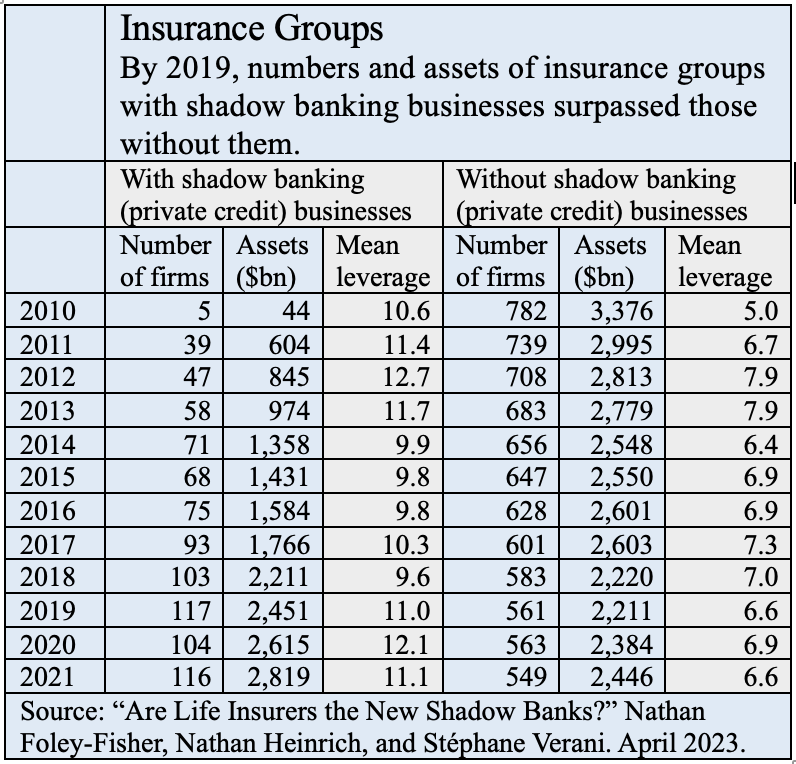
The spread might only be 2%, but the insurer earns upwards of 10% to 15% in return on equity, thanks to leverage. Of $100 billion in reserves that a life insurer invests, for example, its surplus might be only $5 billion. A 2% spread on the invested assets means a $2 billion gain on equity capital of $5 billion. That’s a 40% gross return, which expenses might reduce by two-thirds or more. A 2023 Federal Reserve research paper (see table at right) showed that, from 2010 to 2021, life insurers with “shadow banking” or private credit activities—RIJ’s “Bermuda Triangle”—ran consistently higher average leverage levels than life insurers without such businesses.
Leverage levels at asset-manager-led life insurers have been going up. According to the Federal Insurance Office’s September 2025 Annual Report on the Insurance Industry, “The trend in investment exposure and surplus exposure—with potentially heightened insurers’ exposure to certain risks that can stem from a downward spiral in asset prices, increased issuer leverage, rising defaults, and funding risks—continues to be monitored by FIO. “The asset leverage for privately-owned insurers is somewhat higher” than the insurance industry average, according to ALIRT.
Capital-efficient products. As insurance products go, fixed deferred annuities, and especially fixed indexed annuities (FIAs), are priced for demanding relatively little life insurer capital.
Sold as safe investments and not life-contingent income, and usually running for terms of three to 10 years, fixed deferred annuities don’t carry the decades-long exposure to changing longevity or mortality rates that, say, a traditional immediate income annuity or a life insurance policy would. (Editor’s note: Much of the media seems to confuse deferred annuities with income annuities.)
In the case of FIAs, the contract owners themselves finance an at-the-money call option on an equity index or hybrid index. They use roughly the interest they might have earned on a fixed-rate annuity, adding to this “options budget” by selling rights to index returns above a certain level. Through their management of the volatility controls inside bespoke indices, FIA issuers can put governors on the returns of the index and make their returns more consistent.
When the risk of the liability is under control, the insurer conserves capital, which implicitly raises leverage levels. That capital can be used to increase annuity sales and to help finance bundles of high-yield loans. Purchasers of FIAs, especially those who reach for the highest-yielding contracts, presumably like to see their insurers reaching for yield—they’re banking on the fixed annuities’ no-loss-of-principal guarantees to keep them whole.
Reinsurance. This may be the most overlooked source of leverage in the Bermuda Triangle.
Traditionally, life insurers reduced their leverage ratios by selling books of capital-intensive business to reinsurers to “free up capital.” Many still do. But asset manager-led life/annuity companies have flipped that logic. When they’re not buying blocks of distressed annuity or life insurance business from older life insurers, they’re using reinsurance to reduce the capital requirements triggered by new annuity sales or riskier investments.
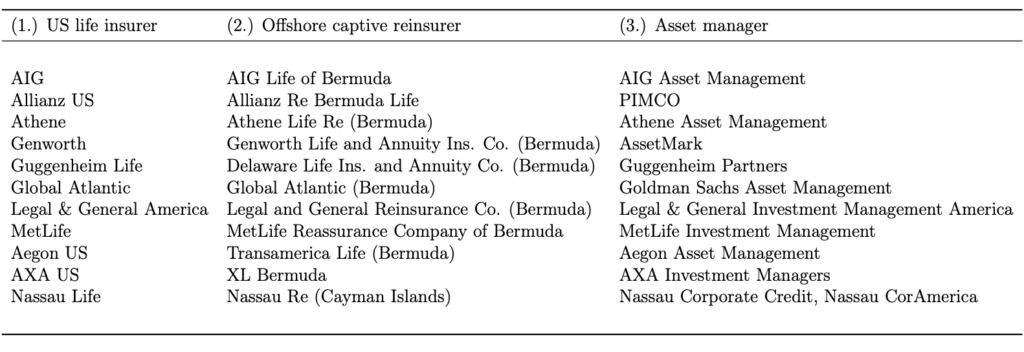
From Foley-Fisher et al, April 2023.
They typically do this in partnership with an affiliated reinsurer—another unit of the same holding company—in Bermuda or the Cayman Islands. The offshore reinsurer can put up the capital to back new sales and assume the risks associated with high-yield lending. Those jurisdictions may require less capital than the U.S. regulators require. Moreover, the Bermuda reinsurer can lever “sidecars”—financed by international institutional investors—for some or most of its capital. That’s another form of leverage.
“Privately-owned life insurers reported much higher reinsurance leverage (both affiliated and unaffiliated) than the life insurance industry in total, the insurance analysts at ALIRT reported in July of this year. “This reflects the greater use of reinsurance among privately-owned carriers as well as the portion of capital held at foreign reinsurance entities in some cases.”
“The vast majority of reserves ceded are covering liabilities for indexed and fixed annuities,” said Best’s Special Report, “Big Year of Growth for Life/Annuity Sidecar-Like Activity in 2025.” “As a result of managing strong premium growth through reinsurance, the individual annuity composite has steadily seen its reinsurance leverage double since 2019. In addition, overall surplus relief of nearly 11% in 2025 was double that of the previous year.”
According to recent Bank of International Settlements research, “By 2023, US life insurers had ceded $2.1 trillion in reserves, up from $500 billion in 2017, representing 25% of their total assets. Offshore reinsurers accounted for 40% of these risks, up from 14% in 2017, with some of this activity occurring in jurisdictions with less stringent regulatory frameworks.”
“PE-influenced reinsurers… account for about half of the assets of all long-term reinsurers in Bermuda,” according to a 2023 International Monetary Fund study. “As of the latest available data in 2021, Bermuda long-term reinsurance assets, a proxy for life reinsurance, grew to more than $1 trillion, about 4% of total life insurance assets globally, doubling their share when compared to the previous four years.”
‘Embedded’ leverage. Life insurers can get exposure to higher-yielding, below-investment grade assets, without a proportionate increase in their capital requirements, by financing investment-grade senior tranches of collateralized loan obligations (CLOs) created or managed by their affiliated asset managers. In effect, the financial engineering process of securitization lets them hold riskier assets without employing as much capital.
The International Monetary Fund calls this “embedded leverage.” According to the IMF, “The National Association of Insurance Commissioners (NAIC) has found that an insurer that owns all the tranches of a collateralized loan obligation with underlying assets of B-rated loans would have a substantial beneficial regulatory capital arbitrage compared to holding directly the underlying B-rated loans based on existing risk-based capital (RBC) calculations for life insurers. NAIC is proposing to address this regulatory capital arbitrage by adding additional NAIC designation categories and relevant RBC factors.”
“An insurer in the U.S. or Bermuda that packages its middle-market loan holdings into a CLO and invests in the entire CLO capital stack could reduce its capital charge by a factor of 10… Insurers holding a portfolio of B-rated loans can cut their risk-based capital charges by two-thirds if they package those loans into a CLO and purchase the entire CLO capital stack,” according to a March 21, 2025, FED Notes bulletin entitled, “Life Insurers’ Role in the Intermediation Chain of Public and Private Credit to Risky Firms.”
The life insurer earns a rate of interest that’s higher than comparably-rated public-market securities, while the asset manager is in a position to earn management fees (CLOs are, or can be, actively managed) and, if it has an interest in the risky equity tranche of the CLO, a return multiplied by all the borrowed money in the CLO stack.
Borrowings from Federal Home Loan Banks. The FHLBs are a system of 11 regionally-based government-sponsored banks providing liquidity to financial institutions to promote housing and community initiatives. Insurers can borrow from the FHLB if they engage in mortgage lending (or hold mortgage-backed securities) and purchase FHLB stock. To receive advances from the FHLB, they post collateral, sometimes using the money they borrowed by issuing funding agreement-backed notes or FABNs (see below).
A June 2026 Best’s Special Report, “Funding Agreements Drive FHLB Borrowings for the L/A Industry in 2025,” states that borrowings in the form of funding agreements totaled $153 billion in 2025, compared with $136 billion in the previous year, as annuity writers have been able to leverage the lower cost of borrowing from the FHLBs and gain a favorable spread on investments. Although the FHLBs provide an inexpensive short-term financing option potentially used to increase investment income, an insurer may be exposed to credit risk, collateral risk and market risk.
According to the report, borrowing capacity grew at a faster rate than borrowings in 2025, increasing by 18%, again heavily driven by annuity writers. “Borrowing capacity is still broadly available, although it is somewhat more limited than in 2019, before the more recent annuity sales boom amid private capital heavily entering the life/annuity industry. Two-thirds of companies used less than half of their available capacity in 2025, which is up from 62% in 2019; however, a notably higher share of companies have outstanding borrowings today as compared with 2019.”
The report added, “Since FHLB funding agreement borrowers are predominantly companies that sell annuities and spread-play business, the investment profile of these borrowers closely mirrors that of the individual annuity composite in asset classes such as private placements and affiliated and high-risk investments, as well as bond yields.”
For example, Delaware Life, which is currently under SEC investigation for understating its degree of lending to affiliated companies, reported in its latest statutory filing that $6.4 billion of its assets are pledged as collateral for its FHLB loans. It was part of the $10.6 billion in “restricted assets” that the company can’t readily liquidate. Delaware Life’s surplus, by comparison, is just $3.9 billion.
The Congressional Research Service, in a March 27, 2025 report to Congress, didn’t comment directly on FHLB loans to life/annuity companies, but noted, “Because Congress created FHLBs to facilitate mortgage market liquidity, public policy discussions often consider the system’s effectiveness at achieving the congressional intent.
“One concern is that many member institutions eligible to join the FHLB system may not be principally engaged in residential mortgage finance, calling into question the extent to which FHLB advances subsidize the funding of mortgages or the funding of member institutions’ asset portfolios in general.” [Emphasis added.]
Funding Agreement Backed Notes. The 1994 invention of “funding agreement backed notes” has been attributed to former SunAmerica CEO and later Athene CEO Jim Belardi. Life insurers can use funding agreements, which are similar to guaranteed investment contracts (GICs), to borrow money in the wholesale money markets. The life insurer sends a funding agreement to a special purpose vehicle (SPV) it creates. The SPV sells notes or securities—interest-paying IOUs—to institutional investors, and passes the proceeds of the sale back to the life insurer.
These borrowings, which are in effect secured by the same general account assets that back the insurer’s obligations to annuity owners, can be used to secure the life insurer’s FHLB advances. The life insurer’s obligations to FABN lenders are said to be “pari passu”—on equal footing—with the insurer’s obligations to contract owners and policyholders.
The chart below, from a 2025 presentation by the American Council of Life Insurers, shows the steady increase in FABN borrowing by life insurers.

FABNs give an insurer a new deposit-like asset and a new insurance liability without changing its surplus. They can, however, increase a carrier’s economic leverage. The table below shows how new FABN debt can change surplus ratios.

Source: ChatGPT and RIJ.
“A highly leveraged insurer with well-matched, liquid assets and widely staggered fixed-term maturities may be manageable,” said a NAIC primer on FABNs. “A rapidly growing insurer funding illiquid private-credit assets with short or concentrated FABNs is considerably more vulnerable. So the appropriate conclusion is: the growth is a legitimate regulatory concern and potentially a systemic-risk signal, especially if it is not visible in conventional leverage statistics. But the danger depends on the structure and use of the funding, not on issuance volume alone.”
The NAIC doesn’t have complete data on the amount of FABN borrowing by life insurers, according to the primer: “Statutory reporting of FABNs by insurers does not exist, making it difficult to accurately assess overall exposure levels and the appropriate matching of assets to liabilities (i.e., whether the duration of the funding agreement matches that of the FABNs issued).
“To address this transparency risk, the NAIC has proposed standards for additional disclosures in insurer annual statement filings for funding agreements that back FABNs. Currently, the only required reporting is the amount of funding agreements issued in aggregate for all purposes, with disclosure of funding agreements issued in connection with FHLB advances.”
Conclusion
There’s a lot of leverage in the Bermuda Triangle. Life/annuity companies in effect borrow by selling annuity contracts, by issuing FABN notes, and by receiving advances from Federal Home Loan Banks. The insurers then finance their asset managers’ private credit operations while money from institutional investors helps capitalize their affiliated reinsurers.
Leverage can be good and bad. On the one hand, it multiplies return on equity. On the other hand, it allows investment companies to take big financial risks with other people’s money. The Bermuda Triangle scares certain regulators and watchdogs—the Federal Reserve, the IMF, the FIO, the BIS, and the NAIC—because its business model is opaque and the securities that its practitioners use as loan collateral can be illiquid, hard to rate and hard to price. Bermuda Triangle companies are good at turning cash into paper assets. But in a crisis, will they be able to turn that paper back into cash?
The private nature of private lending, coupled with fragmented regulation, is bound to make it hard to know who is on the hook to provide the cash and how much money they owe.
“The migration of credit creation and corporate control toward private intermediaries redistributes and reshapes risk rather than eliminating it,” said a recent paper from the CFA Institute’s Research and Policy Center. “As these intermediaries scale, the issue is no longer only leverage and liquidity. It is also accountability—who ensures valuation integrity and transparency—and how standards and supervisory frameworks adapt to protect investors and the stability of the system.”
© 2026 RIJ Publishing LLC. All rights reserved.