


QVT Financial, an investment firm, is shorting Jackson Financial’s (NYSE: JXL) stock. Jackson Financial is the parent of Brooke Life, which is now the parent of Jackson National Life, the largest issuer of traditional variable annuities in 2025 and the fifth-largest issuer of structured variable annuities (“RILAs”), according to LIMRA.
“As of the date of this article, accounts managed by QVT Financial LP… hold short positions in the debt and equity securities of JXN, including through derivatives,” the asset manager wrote in its September 17 report.
Since 2021, when Jackson Financial separated from Prudential Plc and went public, its share price has climbed from $25 initially to about $130. During that rise, Jackson Financial spent more than $1 billion buying back its stock from shareholders.
Where did that money come from? According to QVT, Jackson National Life found it by booking, as an asset, the present value of rider fees that it expects to receive from owners of its variable annuities with guaranteed minimum withdrawal benefits (GMWBs).

Jackson Financial’s share price history since going public, from Reuters.
Under SAP accounting standards, which life insurers use, Jackson National couldn’t book that asset without capitalizing the risk that VA/GMWB owners might lapse their contracts and stop paying rider fees. To manage the pain of that expense, Jackson Financial set up Brooke Re, a captive insurer in Jackson’ home state of Michigan.
Regulators in Michigan allowed Brooke Re to use less-conservative GAAP accounting instead of life insurers’ required SAP accounting. Brooke Re would not need as much capital as Jackson would for the same liability—and “release” capital that Jackson Financial could use elsewhere.
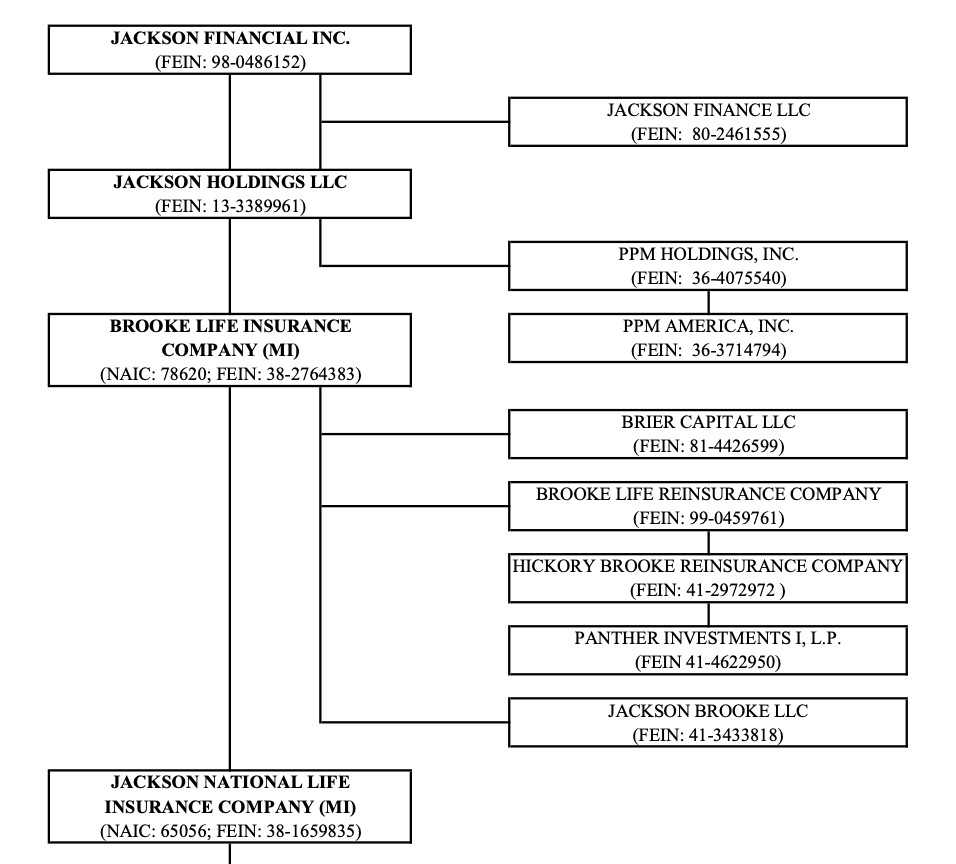
“This permitted practice… increased capital and surplus by $1,348,933,927 and $848,933,927 as of June 30, 2026 and December 31, 2025, respectively,” Jackson National described the arrangement in its 2Q26 state filing. [Jackson explored the possibility of creating an affiliated reinsurer in Bermuda before deciding on a Michigan captive, RIJ was told by someone familiar with that effort.]
QVT isn’t buying it. The investment company says this arrangement gives Jackson capital to support an aggressive share buyback program but leaves Brooke Re underfunded—and perhaps unable to fully reimburse Jackson National in the event of a wave of contract lapses and a write-down in the PV of future fee revenue. So the company, led by Arthur Chu, who has a masters in physics from Harvard, is shorting Jackson Financial’s stock.
“The Brooke Re transaction transferred the bulk of the risk in JNL – the variable annuity market guarantees and their hedges – but only a small fraction of the assets. Brooke Re began with only $700MM of hard assets to hedge a ~$175B variable annuity book. …We calculate that Brooke Re has less than half the liquid assets needed to service its payable to JNL and insufficient capital for the risks it assumed… If Brooke Re cannot service this receivable, JNL will face a significant capital deficit,” said QVT’s white paper.
“In order for public shareholders to receive the capital generated by JNL, JNL first pays dividends to its owner Brooke Life; Brooke Life passes some or all of these proceeds to its owner JXN; these proceeds are then passed to shareholders.”
Is this a problem?
At least one stock analyst thinks so. “One of the questions that we get most often from investors is how do you get comfort that Brooke Re is well capitalized?” Jefferies’ Suneet Kamath asked on a call discussing Jackson’s 2024 results, noting “some reluctance in terms of providing additional disclosure,” according to a report on this matter in Hunterbrook media.
But annuity industry veterans aren’t giving up on Jackson National. “Is this a problem? I’m not sure,” said Larry Rybka, CEO of Valmark Securities, an Akron, Ohio-based independent broker-dealer, in an email to RIJ.
“If it is, the scale of the problem doesn’t approach that of fixed annuity writers that are private equity-owned. As a public company, Jackson has different goals and constraints. At least the Jackson policyholders have their sub-account values. It is also audited by a Big Four accounting firm.”
Bobby Samuelson, publisher of Life Product Review and CEO of Illustra, an illustration tool for life/annuity companies, agreed. “VA with GLWB is one of the most complex liability structures ever written at scale by the insurance industry. There’s a built-in mismatch between GAAP and Stat accounting that every publicly-traded carrier has to manage. This just seems like a mechanism to smooth the results,” he told RIJ.
Jackson, which didn’t respond to my email query, appears to be spreading the cost of hedging the lapse risk over several years, rather than capitalizing it all at once. That strategy is similar to the way life insurers deal with the cost of the up-front commissions (“deferred acquisition costs,” or DAC) that they pay third-party agents and advisers.
“It’s similar to DAC,” an actuary told RIJ. “They’re asking regulators, ‘Why do you allow me to capitalize that under SAP and not this? Both are dependent on the same fee stream.’”
QVT seems to be saying that Jackson National is capitalizing Brooke Life Re in the skimpy way that credit cardholders make minimum monthly payments while their account balances compound at high rates of interest. In that view, the liability just gets uglier, like the painting of Dorian Gray in Oscar Wilde’s 1891 novel.
Here’s how Jackson Financial’s August 2026 investor presentation slide described its hedging strategy.

Is Jackson National a ‘Bermuda Triangle’ life insurer?
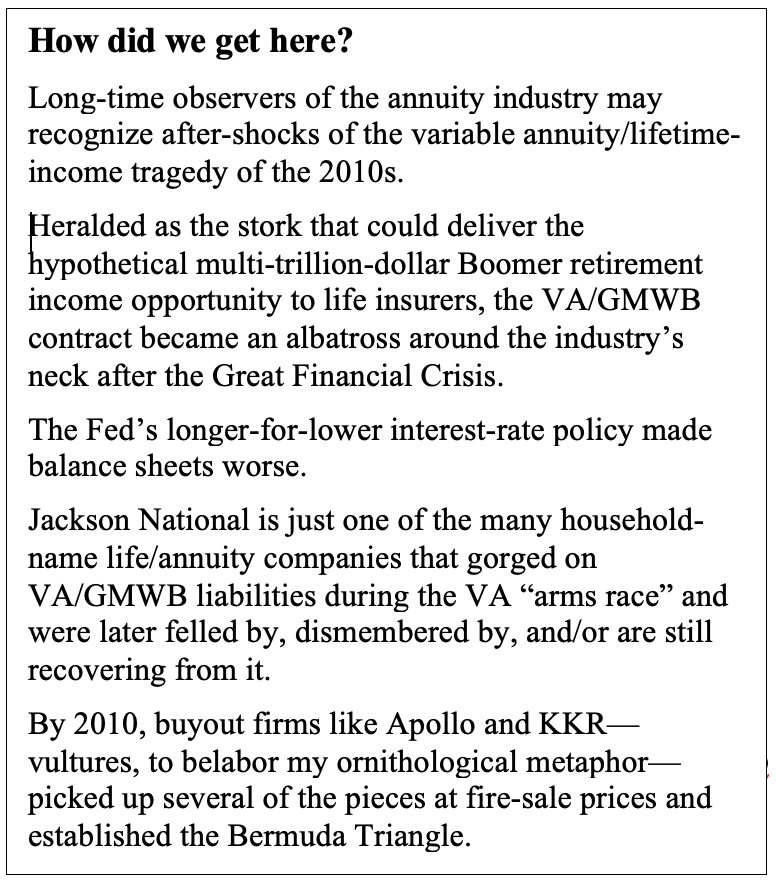
This controversy suggests that Jackson National is adopting the Bermuda Triangle strategy, including its three key elements. That strategy requires a U.S. life insurer, an affiliated reinsurer able to use GAAP accounting, and an affiliated asset manager with private credit chops.
Jackson Financial started out with the first element. It added the second element in 2024. And it added the third element ten months ago.
Last January, Jackson Financial agreed to a long-term strategic investment management partnership with TPG, an alternative asset management firm that’s trying to build its private credit business. According to a release, TPG will manage “a minimum commitment of $12 billion of AUM for Jackson,” with incentives to reach $20 billion.” TPG will focus on investment grade asset based finance (ABF) and direct lending.
Simultaneously, TPG invested $500 million in Jackson, about 6.5% of the insurer. Jackson will receive $150 million of TPG stock at the market price. Jackson could receive additional shares if TPG’s mandate reaches $20 billion.
Does this deal make Jackson Financial, Jackson National and Brooke Re a Bermuda Triangle “flywheel” company (McKinsey’s name for the Bermuda Triangle), like Apollo, Athene and Athene Re?
There are significant differences. Athene is a “PE-led” insurer. Its private equity owner is Apollo, which created Athene in 2009 to take advantage of asset fire-sales at annuity issuers like Jackson National. Athene sells deferred fixed-rate and fixed indexed annuities. It is regulated by the state of Iowa. Its products are distributed insurance licensed advisers and agents via independent marketing organizations. Athene’s core mission is apparently to buy high-yield private market assets that Apollo, as SEC-regulated public company, originates.

Jackson National, created in 1961, is an insurer-led insurer. Its primary product is annuities, not private market assets. Jackson Financial is a public company that reports to the SEC, but Jackson National Life, the operating company, is regulated by the state of Michigan. It sells variable annuities (traditional and, increasingly, RILAs). They are SEC-registered annuities, distributed by SEC-regulated broker-dealers and sold by registered brokers and advisers.
There’s a significant difference in the way Athene and Jackson National have used affiliated reinsurance to date. For instance, in the chart below, note that Athene uses ceded reinsurance to greatly reduce the amount of new liabilities (and thereby lower required capital) associated with its annuity sales. Jackson National does not appear to.

But there is a similarity between Jackson National (and other RILA issuers) and Bermuda Triangle companies, and it’s an important one. RILAs and FAs are both general account products. Confusingly, RILA assets are described as “non-insulated” separate account assets in Jackson National’s 2Q2026 state filing (p. 7.16). Either way, the RILA issuer, not the contract owner, decides how to invest the underlying reserves. Below: a Jackson Financial August 2026 investor-day slide depicting the company’s retooling since its separation from Prudential Plc five years ago.

So Jackson can invest at least some of the reserves backing its RILAs—its future flagship—in private market assets that TPG or other alt-asset managers bring to it. In transitioning from a traditional VA separate account company to a RILA general account (or uninsulated separate account) annuity issuer, Jackson National plants at least one foot in the Bermuda Triangle.
If so, then Jackson Financial’s senior management may be playing a longer game than QVT, with its short position, seems to think.
© 2026 RIJ Publishing LLC. All rights reserved.